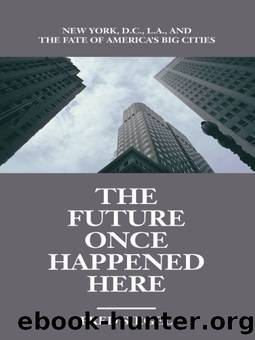
The Future Once Happened Here: New York, D. C. , L. A. , and the Fate of America's Big Cities by Fred Siegel
Author:Fred Siegel [Siegel, Fred]
Language: eng
Format: epub
Tags: History, Politics
ISBN: 9781459604117
Google: -bYEySUg9LIC
Goodreads: 11022969
Publisher: ReadHowYouWant
Published: 1997-01-01T00:00:00+00:00
THE STORY OF BLACK L.A. can be described in terms of a trajectory that brought a historically marginal community into the center of a governing coalition during the Bradley years of 1973 to 1993 and then returned it to isolation. The same trajectory limns the rise and fall of another L.A. anomalyâa broadly appealing civic ideal.
Blacks have long been better off materially in L.A. than in the rest of the country. As early as the 1930s, Watts had the highest rate of black home ownership in the country. And blacks benefited from the World War II boom when Japanese internment and Mexican deportations created a demand for low-wage African-American labor. By 1964, the year prior to the Watts riots, an Urban League âstatistical portraitâ rated L.A. the best of sixty-eight cities for black employment, housing, and income. âIn a Third World setting,â wrote the much-traveled author Paul Theroux, âWatts would be upper middle class because its drug dealers would have been long since executed.â Thirty years later the picture still holds. L.A. is Americaâs leading city for black-owned business, and blacks in L.A. are twice as likely to be living above the poverty line as their Chicago brethren.
In the wake of the violent sixties, a coalition of two Los Angeles out-groupsâblacks and Jewsâwhose economic success far exceeded their political clout, established a new political regime. This alliance, which produced record electoral turnout, elected an African-American, Tom Bradley, mayor in 1973 with 46 percent of the white vote. Bradleyâs election gave Jews the political recognition they lacked under the old white Protestant political regime, which had been run by a group of city fathers known as the Committee of 25. It also promised to integrate blacks into the economic life of L.A. through affirmative action contracting and the vigorous pursuit of federal antipoverty money.
The coalition was built on a mix of what seemed to be black self-interest and a blend of fear and concern on the part of moderate and liberal whites, whose desire to âhelpâ was matched by their need to propitiate black anger. For a time, the coalition, in the best spirit of Dr. King, gave the city a public ethos that partially transcended ethnic affiliations.
In some ways the Bradley mayoralty was a success. Less than a fifth of the population, blacks gained considerable political ground. âThe most striking fact,â noted Rafael Sonenshein, the historian of the black-Jewish alliance, âis that since 1973 every citywide candidate backed in the black community won election.â Sonenshein also noted that âwhen on occasion white liberals and the blacks clashed over candidates, the blacks won.â One consequence was a sharp rise in black public employment; blacks came to be overrepresented on local government payrolls.
From 1973 to 1985 the liberal coalition behind Bradley dominated Los Angeles politics. The coalition had important limitations. It was unable to incorporate the middle-class homeowners of the San Fernando Valley and Latinos into political life or blacks into the booming private sector economy. At its best the coalition, in the person of Bradley, embodied a trans-tribal ethic.
Download
This site does not store any files on its server. We only index and link to content provided by other sites. Please contact the content providers to delete copyright contents if any and email us, we'll remove relevant links or contents immediately.
The Secret History by Donna Tartt(19102)
The Social Justice Warrior Handbook by Lisa De Pasquale(12197)
Thirteen Reasons Why by Jay Asher(8918)
This Is How You Lose Her by Junot Diaz(6893)
Weapons of Math Destruction by Cathy O'Neil(6284)
Zero to One by Peter Thiel(5807)
Beartown by Fredrik Backman(5765)
The Myth of the Strong Leader by Archie Brown(5512)
The Fire Next Time by James Baldwin(5453)
How Democracies Die by Steven Levitsky & Daniel Ziblatt(5223)
Promise Me, Dad by Joe Biden(5156)
Stone's Rules by Roger Stone(5089)
A Higher Loyalty: Truth, Lies, and Leadership by James Comey(4966)
100 Deadly Skills by Clint Emerson(4930)
Rise and Kill First by Ronen Bergman(4796)
Secrecy World by Jake Bernstein(4756)
The David Icke Guide to the Global Conspiracy (and how to end it) by David Icke(4721)
The Farm by Tom Rob Smith(4516)
The Doomsday Machine by Daniel Ellsberg(4493)
